

Published September 2026 · ~7 min read
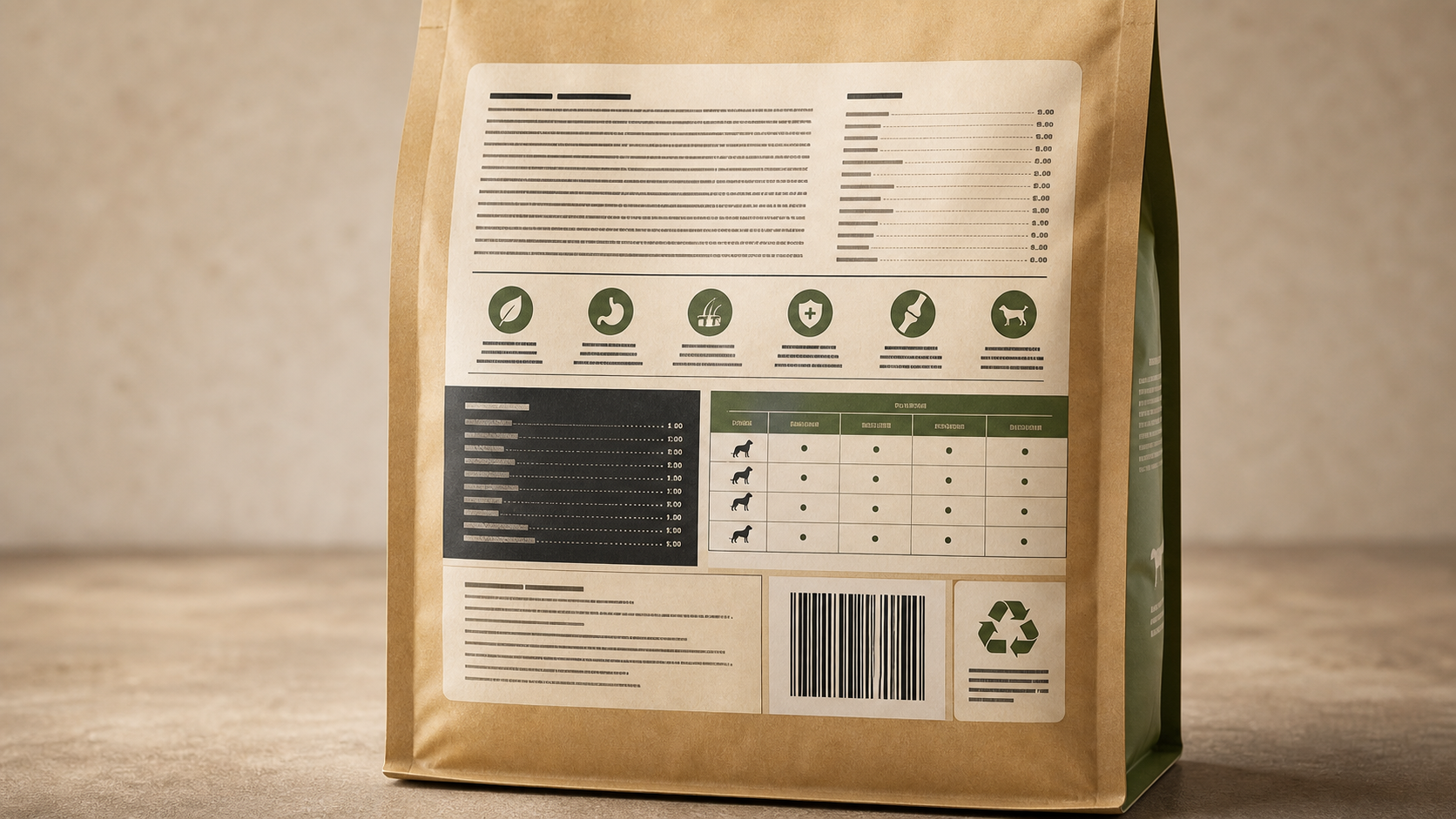
Stand in front of any wall of pet food and every bag is shouting something: ancestral, holistic, premium, grain-free, farm-raised. Some of those words carry real information; many are just marketing. The useful truth is printed in smaller type on the back. Once you know how to read four things (the ingredient list, the guaranteed analysis, the life-stage statement and the feeding guide), you can size up any food in about a minute. Here’s the decoder our team uses on the floor every day.
Start with the ingredient list, and how it’s ordered
Ingredients are listed by weight, heaviest first, measured before cooking. That ordering hides one important wrinkle: fresh meat is roughly 70% water, so “fresh chicken” at the top of the list weighs a lot going in but cooks down considerably in a dry kibble. That’s why a quality label often shows several named animal proteins in the first handful of ingredients (fresh chicken and chicken meal, for example) rather than one meat followed by a long run of starches. As a quick screen: look at the first five ingredients, and you’re looking at most of what’s in the bag.
What does “chicken meal” actually mean?
Meal is meat with the water cooked out, leaving a concentrated, rendered protein source. A named meal (chicken meal, lamb meal, salmon meal) is a perfectly good ingredient, not a filler. Because the water is already gone, a meal listed high on a dry-food label often contributes more actual protein than fresh meat listed first. The label to read more skeptically is the vague one: “meat meal” or “animal meal” with no species named tells you the source can vary batch to batch. Named species, whether fresh or meal, is the mark of a company being specific with you.
Are by-products bad?
Not inherently. “By-products” mostly means organs and other parts beyond muscle meat, and organs are among the most nutrient-dense things an animal can eat (wild canines and felines eat them first). The fair questions are the same as with meal: is the species named, and do you trust the company’s sourcing? Plenty of excellent foods use named organ meats proudly on the label (liver, heart, tripe) while others use the generic term. Treat “by-products” as a neutral word that deserves a closer look, not an automatic red flag.
The guaranteed analysis: minimums and maximums, not exact amounts
That little table guarantees a minimum of crude protein and fat and a maximum of fibre and moisture. It’s a floor and a ceiling, not a recipe printout. The trap to know: you can’t compare a wet food’s numbers directly to a dry food’s, because wet food is mostly water. A canned food listing 10% protein at 78% moisture is actually more protein-dense, once the water is removed, than a 30% protein kibble at 10% moisture. The quick fix when comparing across formats: divide the protein percentage by the percentage of dry matter (100 minus moisture). It takes ten seconds and it’s the honest comparison.
The most important line: “complete and balanced” for a life stage
Somewhere on the bag is a nutritional adequacy statement. Look for wording like “complete and balanced,” usually referencing AAFCO nutrient profiles, for a named life stage: growth (puppies and kittens), adult maintenance, or all life stages. This single line tells you the food is formulated to be fed as the whole diet, and to whom. A growing puppy or kitten needs a food that says growth or all life stages. Adult maintenance food doesn’t carry enough to build a body. (Worth knowing: pet food labelling is less tightly regulated in Canada than human food, and reputable Canadian brands voluntarily formulate to these standards, which is one more reason the statement matters.) Our puppy food guide digs deeper into the growth side.
Marketing words vs. meaningful words
Here’s the honest split. Words with no regulated definition on a pet food bag: premium, super-premium, holistic, gourmet, natural (loosely defined at best). Words that carry real information: a named species on every protein, a named life stage, “complete and balanced,” a disclosed manufacturer and country of origin, and specifics like “made in Canada” from a company that tells you where. Brands that are proud of their sourcing tend to say so precisely. Our deep dives on Acana & Orijen and Eukanuba show what that specificity looks like in practice.
How to compare two bags in 60 seconds
- First five ingredients: how many are named animal proteins?
- Adequacy statement: complete and balanced, and for the right life stage?
- Guaranteed analysis: protein and fat in the range your pet needs (and dry-matter adjusted if you’re comparing wet to dry)?
- Named specifics: species on every meal and by-product, a real company, a country of origin?
- Feeding guide sanity check: a calorie-dense food feeds less per day than the bag price suggests, so cost per day beats cost per bag.
A quick word on grain-free
Grain-free and grain-inclusive are both legitimate formats, and the right answer is the dog or cat in front of you: coat, stool quality, energy and any sensitivities. If you’re weighing a switch, change over 7–10 days and loop in your veterinarian, especially for pets with health conditions. Browse the full dog food collection with fresh label-reading eyes and the back of the bag starts doing the talking.
The bottom line
Ignore the front of the bag; read the back. Named proteins high in the ingredient list, a complete-and-balanced statement for the right life stage, a guaranteed analysis you’ve compared fairly, and a company that names its sources: that’s the whole skill. Master those four checks and no amount of packaging can steer you wrong.
PetMax.ca is a Canadian-owned pet supply retailer based in the GTHA. We’ve been helping pet owners since 1993 and ship across Canada, with free shipping on orders over $89* conditions apply. This article is general information, not veterinary advice. When in doubt about your pet’s health, contact your veterinarian.



Share:
The Labour Day Long Weekend With Your Dog: One Last Summer Checklist (2026)
New at PetMax This Fall: Coats, Beds & Fresh Arrivals (2026)