

Published October 2026 · ~7 min read
Halloween lands on a Saturday this year, which means a long evening of doorbells, masked strangers on the porch, and a house stocked with more candy than usual. For pets, that combination adds up to two big risks: getting into the treat bowl, and getting overwhelmed (or out the door) during the trick-or-treat rush. Here’s our team’s guide to both, starting with the question vets hear most on November 1.
Quick answer: If your dog eats chocolate, call your vet, an emergency clinic or a pet poison helpline right away, with your dog’s weight, the type of chocolate and the amount handy. Darker chocolate is more dangerous: baking chocolate and cocoa powder contain many times more of the toxic compounds than milk chocolate. Don’t make your dog vomit unless a vet tells you to. Signs usually appear within 6 to 12 hours and can last up to three days.
My dog ate chocolate. What should I do?
- Move your dog away and figure out what was eaten. Grab the wrappers: the type of chocolate and roughly how much matter most, along with your dog’s weight.
- Call for advice right away, even if your dog seems fine. Contact your vet or an emergency clinic. After hours, the Pet Poison Helpline (1-855-764-7661) serves Canada 24/7 for a one-time $89 fee per incident, and the ASPCA Animal Poison Control Center (1-888-426-4435) is also available 24/7 (a consultation fee applies).
- Don’t induce vomiting at home unless a vet or poison helpline tells you to. Home remedies like hydrogen peroxide and salt can cause serious harm of their own, and should never be used on cats.
- Watch closely. Signs include vomiting, diarrhea, restlessness, panting, excessive thirst and urination, a racing heart, tremors and, in severe cases, seizures. They usually start within 6 to 12 hours and can last up to 72 hours.
How much chocolate is toxic to a dog?
It depends on the type of chocolate and the size of the dog. Chocolate contains theobromine and caffeine, and according to the Merck Veterinary Manual, mild signs can appear at about 20 mg per kg of body weight, heart effects at 40–50 mg/kg, and seizures at 60 mg/kg and above. Here’s what that means in real chocolate for a 10 kg (22 lb) dog, like a Beagle or a Cocker Spaniel:
| Type of chocolate | Toxic compounds (approx.) | Enough for mild signs in a 10 kg dog |
|---|---|---|
| White chocolate | 0.04 mg per gram | Very little risk from theobromine; the fat and sugar can still upset a stomach |
| Milk chocolate | 2.3 mg per gram | About 87 g, roughly two full-size bars |
| Dark or semi-sweet | 5.3–5.6 mg per gram | About 36 g, less than one bar |
| Unsweetened baking chocolate | 15.5 mg per gram | About 13 g, around half a baking square |
| Cocoa powder (dry) | 28.5 mg per gram | About 7 g, roughly a heaping tablespoon |
Figures are approximate and vary by brand. Double these amounts can affect the heart. A smaller dog is at risk from proportionally less. Always call for advice rather than relying on a chart; the Merck Veterinary Manual also has a chocolate toxicity calculator your vet may use.
Cats rarely go for chocolate, but it’s toxic to them too, so keep it out of reach of every pet in the house.
Which Halloween treats are more dangerous than chocolate?
Two of them can be worse than a few chocolate bars, and neither is obvious:
| Hazard | Why it’s risky | What to do |
|---|---|---|
| Xylitol (sugar-free gum, candy, mints; some peanut butters and baked goods) | In dogs, can cause a dangerous drop in blood sugar within 30 minutes, and liver failure at higher doses. Also labelled “birch sugar” or “wood sugar.” | Call your vet immediately; don’t wait for signs |
| Raisins (those mini boxes) | Linked to kidney failure in dogs, with no known safe amount | Call your vet immediately |
| Wrappers, foil and lollipop sticks | Can cause choking or a blockage in the intestines | Call your vet; watch for vomiting, straining or not eating |
| Glow sticks and glow jewellery | Very bitter liquid causes dramatic drooling but is rarely serious | Offer (don’t force) a little tuna water or broth; wipe the liquid off fur |
| Candles in jack-o’-lanterns | Burns and knocked-over flames from wagging tails and curious cats | Use battery-powered candles |
The FDA notes that xylitol also turns up in chewable vitamins, toothpaste and some liquid medicines, so the candy bowl isn’t the only place to look. Merck and VCA report that cats don’t appear to be at risk from xylitol, but keep sugar-free candy away from them anyway. And once the carving is done, keep jack-o’-lanterns out of reach; our pumpkin guide explains why a mouldy porch pumpkin is a hazard, while plain canned pumpkin is a treat.
Should my pet wear a Halloween costume?
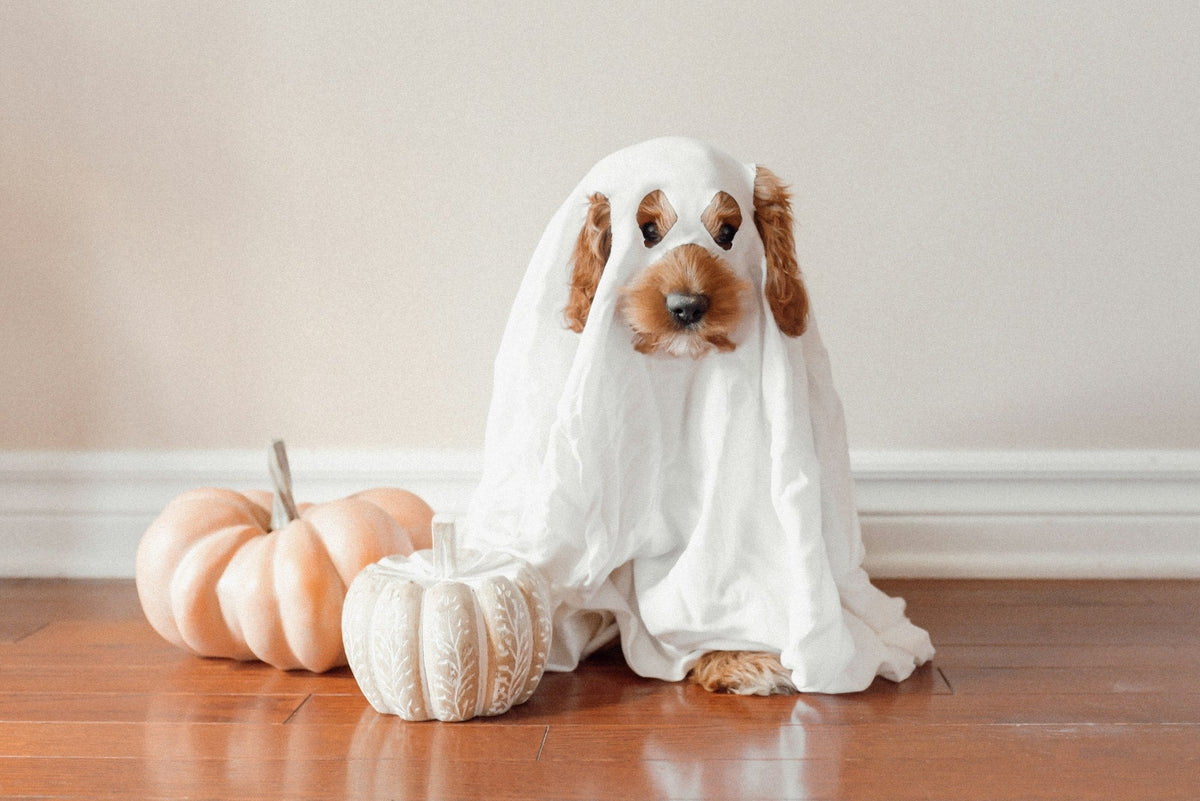
Only if they genuinely enjoy it. The ASPCA’s rule of thumb: a costume should never restrict your pet’s movement, sight, hearing, breathing, or ability to bark or meow, and it shouldn’t have small, dangling or easily chewed pieces. Try it on for a few minutes a day or two ahead, reward calm behaviour, and watch for flattened ears, a tucked tail, freezing or scratching at it, which mean “no thanks.” A festive bandana is the easy, comfortable middle ground, and it makes for great photos.
How do I keep my pet calm on trick-or-treat night?
Plan the evening around them. A doorbell every few minutes and strangers in masks can be a lot, even for easygoing pets. What works well:
- Walk and feed early. A tired, fed dog before the first knock is a calmer dog.
- Set up a quiet room. A bedroom with the door closed, their bed, water, soft music or white noise, and something to do. A stuffed KONG Classic or a frozen Woof Pupsicle can keep a dog happily busy through the busiest hour.
- Skip the doorbell altogether. Sit on the porch with the candy bowl, or leave a note asking trick-or-treaters to knock softly.
- Use calming support for sensitive pets. A spritz of Adaptil calming spray on your dog’s bandana, a Feliway Optimum diffuser for cats (plug it in a few days ahead), or a calming supplement like Nutrience Care Calming for cats. Browse our calming collection, and see our calming guide for pets with bigger fears.
- Guard the door. An open door and a nervous pet is how Halloween escapes happen. Use a baby gate or keep your dog leashed or in their room, and make sure ID tags and microchip details are up to date before the night.
Is it safe to take my dog trick-or-treating?
For a calm, social dog, a short neighbourhood stroll can be fun. Walk early, keep the leash short, and watch the ground closely, since dropped candy and wrappers are everywhere by 8 p.m. It’s dark by then, so make your dog easy to see with a light-up harness like the RC Pets Nova LED harness or the RC Pets Luna reflective vest. If your dog is nervous around strangers, costumes or kids, the kinder choice is a quiet night at home.
Are black cats in danger at Halloween?
Less than the old stories suggest. An analysis by Shelter Animals Count found no reliable data that black cats are targeted at Halloween and called it an urban myth, and black cats actually have a strong adoption rate. That said, Halloween night is noisy and chaotic, so it’s a good night to keep every cat indoors, whatever their colour.
The bottom line
Keep the candy up high and the wrappers in a lidded bin, know what to do if your dog gets into chocolate, and give your pets a calm, quiet space when the doorbell starts ringing. If something does get eaten, call your vet or a poison helpline right away, because quick advice makes all the difference. Happy Halloween from all of us at PetMax.
PetMax.ca is a family-owned, Canadian pet supply retailer based in Hamilton, Ontario. We’ve been helping pet owners since 1993, ship across Canada with free shipping on orders over $89*, and offer free local delivery in Hamilton and Burlington on orders over $30*. This article is general information, not veterinary advice. When in doubt about your pet’s health, contact your veterinarian.
*Conditions Apply
Share:
The Best Dry Cat Food in Canada (2026 Guide): Our Picks for Indoor Cats, Kittens, Seniors & Sensitive Stomachs
Clocks Fall Back November 1: How to Keep Your Dog & Cat on Schedule (2026 Canada Guide)