

Published November 2026 · ~9 min read
Every winter our team hears the same question at the counter: is it too cold to walk the dog today? There’s no single magic number, because a Husky and a Chihuahua live through very different winters. There are useful guidelines, though, and this guide puts them in one place: a temperature chart by dog size, what wind and wet weather do to it, coats, boots, road salt, and the warning signs that mean it’s time to call your vet.
Quick answer: Based on the Tufts weather safety scale, small dogs move into the potentially unsafe range at about 5°C (41°F) and the potentially life-threatening range at about -7°C (20°F), while medium, large and giant dogs reach that top-risk range at about -11°C (12°F). Wind chill, a wet coat, a short or thin coat, puppyhood, old age and illness all lower your dog’s limit. On very cold days, keep walks short, use a coat and boots for dogs who need them, and wipe paws after every walk.
How cold is too cold for a dog?
For a healthy small dog, temperatures below about 5°C (41°F) start to be potentially unsafe, and below about -7°C (20°F) they can become life-threatening; bigger dogs cope a few degrees colder. The chart below is a general guideline adapted from the weather safety scale in the Tufts Animal Care and Condition (TACC) scales (Patronek, 1997), the source behind most “too cold to walk your dog” charts shared online. Tufts scores risk from 1 (no evidence of risk) to 5 (potentially life-threatening). We converted its Fahrenheit scale to Celsius and grouped it into bands, so treat every number as approximate.
| Air temperature | Small dogs | Medium to large dogs | Very large and giant dogs | Suggested walk (our team’s rule of thumb) |
|---|---|---|---|---|
| 7°C (45°F) and warmer | Low risk (score 1–2) | Low risk (1–2) | Low risk (1–2) | Your dog’s normal walk |
| 6°C to 0°C (43°F to 32°F) | Potentially unsafe (3) | Risk unlikely to potentially unsafe (2–3) | Risk unlikely to potentially unsafe (2–3) | Normal walk for most dogs; a coat for small, short-coated, young and senior dogs |
| -1°C to -6°C (30°F to 21°F) | Dangerous situation developing (3–4) | Potentially unsafe to dangerous (3–4) | Potentially unsafe (3) | Small and short-coated dogs: about 15–20 minutes, with a coat. Larger dogs: a normal walk if comfortable |
| -7°C to -10°C (20°F to 14°F) | Potentially life-threatening (5) | Dangerous (4) | Potentially unsafe to dangerous (3–4) | Small dogs: quick potty breaks. Bigger dogs: about 10–15 minutes, with a coat and boots as needed |
| -11°C (12°F) and colder | Potentially life-threatening (5) | Potentially life-threatening (5) | Potentially life-threatening (5) | Potty breaks for most dogs |
Tufts also adjusts the score for the individual dog in cold weather: add 1 point for a toy breed, a puppy under six months or an elderly dog, add 2 points for a dog out in rain or sleet, and subtract 1 point each for a northern or heavy-coated breed, good shelter and bedding, or a dog acclimatized to the cold. The scale’s authors add that how long a dog is out matters as much as the temperature. A lean dog has less insulation too (our body condition guide shows how to check), and your own dog’s comfort is always the final word.
How do wind chill and wet weather change the numbers?
Both make it colder for your dog than the thermometer says, so on windy or wet days, read the chart using the “feels like” temperature. Environment and Climate Change Canada notes that at a wind chill of -28 to -39, exposed human skin can freeze in 10 to 30 minutes, faster in winds over 50 km/h. A dog’s ears, pads and tail tips are their exposed skin.
The Merck Veterinary Manual notes that wet animals chill easily and that frostbite is more likely in wet or windy weather, which is why Tufts adds two points for rain or sleet. A slushy 0°C day can be harder on a short-coated dog than a dry, still -5°C morning, so towel your dog off as soon as you’re home.
Locally, the City of Hamilton’s Medical Officer of Health issues a Cold Alert when the temperature drops, or is expected to drop, below -15°C, or feels like -20°C with wind chill. Every size of dog is in the top-risk band by then, so treat a Hamilton Cold Alert or an Environment Canada extreme cold warning as a potty-breaks-only day.
Which dogs feel the cold first?
Small, short-coated, lean, very young and older dogs feel it first, along with dogs who have health problems. Cornell’s Riney Canine Health Center lists small breeds, puppies (who can’t properly regulate their body temperature), short- or thin-coated, older, underweight and medically compromised dogs, and dogs not used to the cold. Dogs with arthritis often stiffen up and struggle on ice, and if your dog has an ongoing health condition, ask your vet what’s safe. Our senior hip and joint guide, senior dog food guide and pain signs guide can help with older dogs. Healthy northern and heavy-coated breeds (Huskies, Malamutes, Bernese Mountain Dogs) who are used to the cold cope best, though they still need shelter from the worst wind.
How long should I walk my dog in the cold?
Below freezing, shorter and more often is the rule: two or three brisk 10–20 minute outings usually beat one long walk. The walk column in our chart is a starting point, not a prescription, and the Ontario SPCA recommends only short periods outside in very cold weather. Head home right away if your dog shivers, hunches, whines, slows down or stops, looks for shelter, or lifts and holds up a paw.
With early sunsets, many winter walks happen in the dark, so a RC Pets Starling reflective jacket, Luna high visibility vest or Nova LED harness helps drivers see you both (more in our clocks fall back guide). For local ideas, see our Hamilton and Burlington winter walks guide and 30 tips for walking your dog in winter.
Does my dog need a coat or sweater?
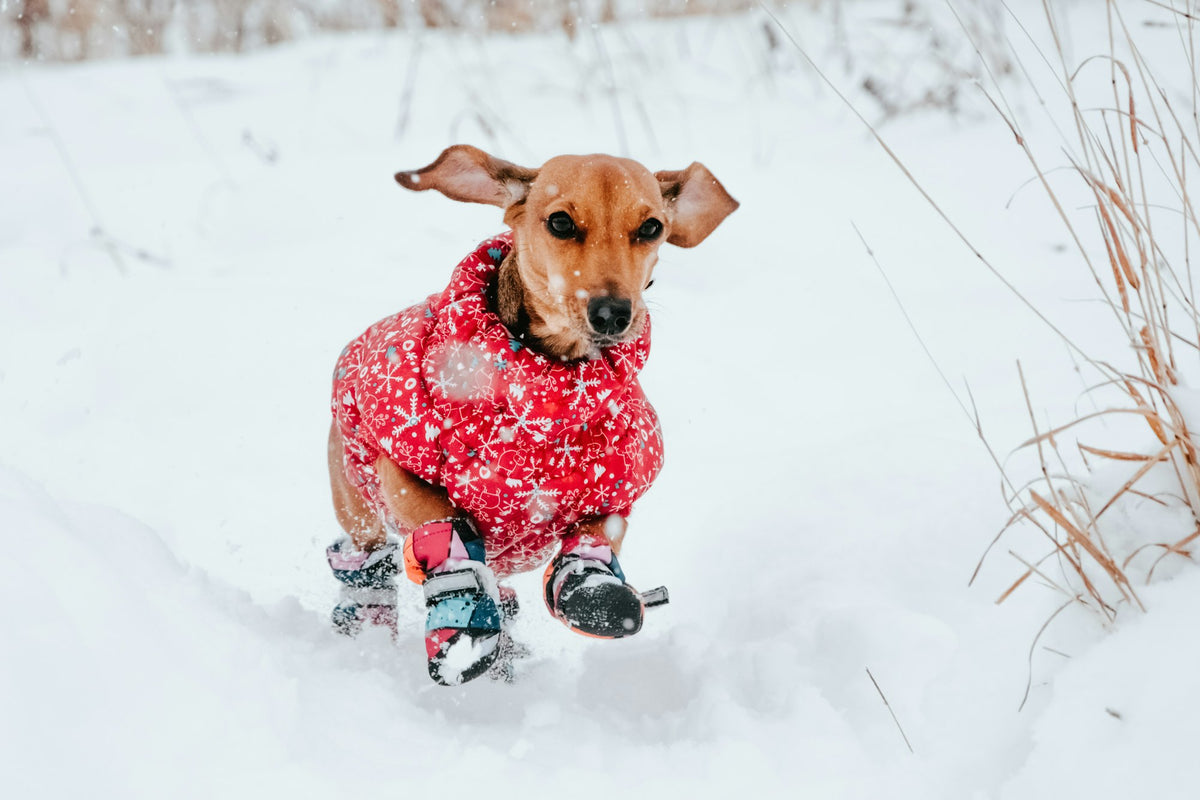
Small, short-coated, lean, young and senior dogs usually benefit from a coat near or below freezing; heavy-coated northern breeds usually don’t. Cornell notes that a jacket covering most of the body also stops snowballs building up on the belly and chest. A sweater suits dry cold; on wet days, choose a water-resistant shell. Don’t shave your dog for winter, the Ontario SPCA adds, apart from removing mats.
To fit a coat, measure from the base of the neck to the base of the tail, and around the widest part of the chest. It should be snug, with room for two fingers underneath, and shouldn’t rub under the front legs. Good options include the RC Pets Cascade coat, RC Pets District parka and Shedrow K9 Chinook coat, or for a lighter layer, the RC Pets Baseline fleece, GF Pet Chalet sweater or Shedrow K9 Brentwood cable knit. Browse all dog coats and winter jackets and sweaters and knits, or bring your dog in to try sizes.
Does my dog need boots, and is road salt bad for paws?
Boots aren’t essential for every dog, but they’re the best protection from road salt, ice and frozen ground, and Cornell notes that well-fitting booties can help with balance on slippery surfaces. Salt and other de-icers can irritate and burn paw pads, and Merck notes that salt licked off paws can cause vomiting within several hours, which can progress to weakness, diarrhea, muscle tremors and seizures. Call your vet if you see those signs after a salty walk.
- Boots. Muttluks fleece-lined boots (from a Toronto company that has made dog boots since 1994) have leather soles and reflective straps, Pawz natural rubber boots go on without zippers or straps, and the RC Pets Strider boot is another popular pick. Measure the paw while your dog stands on it, and introduce boots indoors with treats. See all boots for dogs.
- Paw wax or balm. If boots aren’t for your dog, Musher’s Secret or Dr. Maggie Paw Protector before walks helps shield pads and prevent cracking. More in our ear and paw care collection.
- Wipe after every walk. Use a damp towel on paws and underside, dry well, and check between the toes for ice balls and cracks.
- At home, use a pet-safer ice melt like Paw Thaw and follow the label. Our summer paw protection guide covers the other half of the year.
What are the signs of hypothermia and frostbite in dogs?
Hypothermia shows up as weakness, confusion and slow, shallow breathing; frostbite shows up as pale or red, swollen, painful skin on the ears, tail or paws. Both need your vet. Based on Merck and Cornell:
| Hypothermia (whole body too cold) | Frostbite (frozen skin) | |
|---|---|---|
| Where | The whole body | Ear tips, tail tip, paws and toes |
| Early signs | Slowing down, seeking warmth (Merck notes shivering isn’t a reliable sign of hypothermia in pets) | Pale or red, swollen skin that is painful to touch |
| Serious signs | Weakness, disorientation, shallow breathing, slow pulse, collapse | Skin that turns dark and hard; damage can take days to show |
| What to do | Wrap in a blanket, move somewhere warm, call your vet now | Move indoors, warm gently with warm (not hot) water, call your vet |
Call your vet or an emergency clinic now if your dog is weak, wobbly, confused or unusually sleepy after being in the cold, breathes slowly or shallowly, collapses, or has skin on the ears, tail or paws that stays pale, grey or dark after warming.
Why is antifreeze dangerous for dogs in winter?
Antifreeze containing ethylene glycol tastes sweet, and a tiny amount can kill: Merck puts the lethal dose at 3–4 teaspoons for a dog and 1–2 for a cat. Wipe up drips right away, store containers out of reach, and steer clear of slushy parking lot puddles. If you think your dog licked any, don’t wait for signs: call your vet or an emergency clinic immediately, or Pet Poison Helpline at (855) 764-7661 (24/7, a fee applies).
For cat owners: the Ontario SPCA recommends keeping cats indoors in cold weather. Outdoor and community cats often curl up under car hoods for warmth, so knock on the hood before starting your car on a cold morning.
What are Ontario’s rules for dogs kept outdoors in winter?
Under Ontario’s PAWS Act, a dog is “kept outdoors” if it’s outside for 60 or more continuous minutes without its owner present. According to the Ontario government, it must then have protection from cold-related distress, a waterproof shelter with an insulated roof, a raised dry floor and bedding at least three inches (about 7.5 cm) thick, and water that is not frozen. A dog with an injury or illness that affects its ability to regulate temperature must not be kept outdoors, and puppies under six months must not be tethered. This is a summary, not legal advice. To report an animal in distress, call 1-833-9-ANIMAL (264625).
How can I keep my dog active indoors on the coldest days?
Brain games tire dogs out too, so on potty-break days, swap distance for sniffing and problem-solving. Stuff a KONG Classic with part of a meal, scatter kibble in a Dexypaws snuffle mat, or let them work a KONG Wobbler. Hide-and-seek, short training sessions and gentle tug help too. Our puzzle toy guide, winter wellness guide and winter safety tips have more ideas.
The bottom line
Most healthy dogs are fine on a normal walk above about 7°C. Below freezing, small, short-coated, young, senior and unwell dogs need a coat, shorter outings and a watchful eye, and below about -7°C (or during any Hamilton Cold Alert), quick potty breaks are the safe choice for most dogs. Go by the “feels like” temperature, keep your dog dry, protect their paws, and call your vet for any sign of hypothermia or frostbite. For help fitting a coat or boots, visit us on Nebo Road or browse our winter apparel for dogs.
PetMax.ca is a family-owned, Canadian pet supply retailer based in Hamilton, Ontario. We’ve been helping pet owners since 1993, ship across Canada with free shipping on orders over $89*, and offer free local delivery in Hamilton and Burlington on orders over $30*. This article is general information, not veterinary advice. When in doubt about your pet’s health, contact your veterinarian.
*Conditions Apply

Share:
The Best Senior Dog Food in Canada (2026 Guide): Our Picks for Small, Large & Sensitive Older Dogs
Holiday Gift Guide for Dogs & Cats 2026: Best Gifts by Budget, From Stocking Stuffers to Big Gifts (Canada)