

Publié en septembre 2026 · ~7 min de lecture
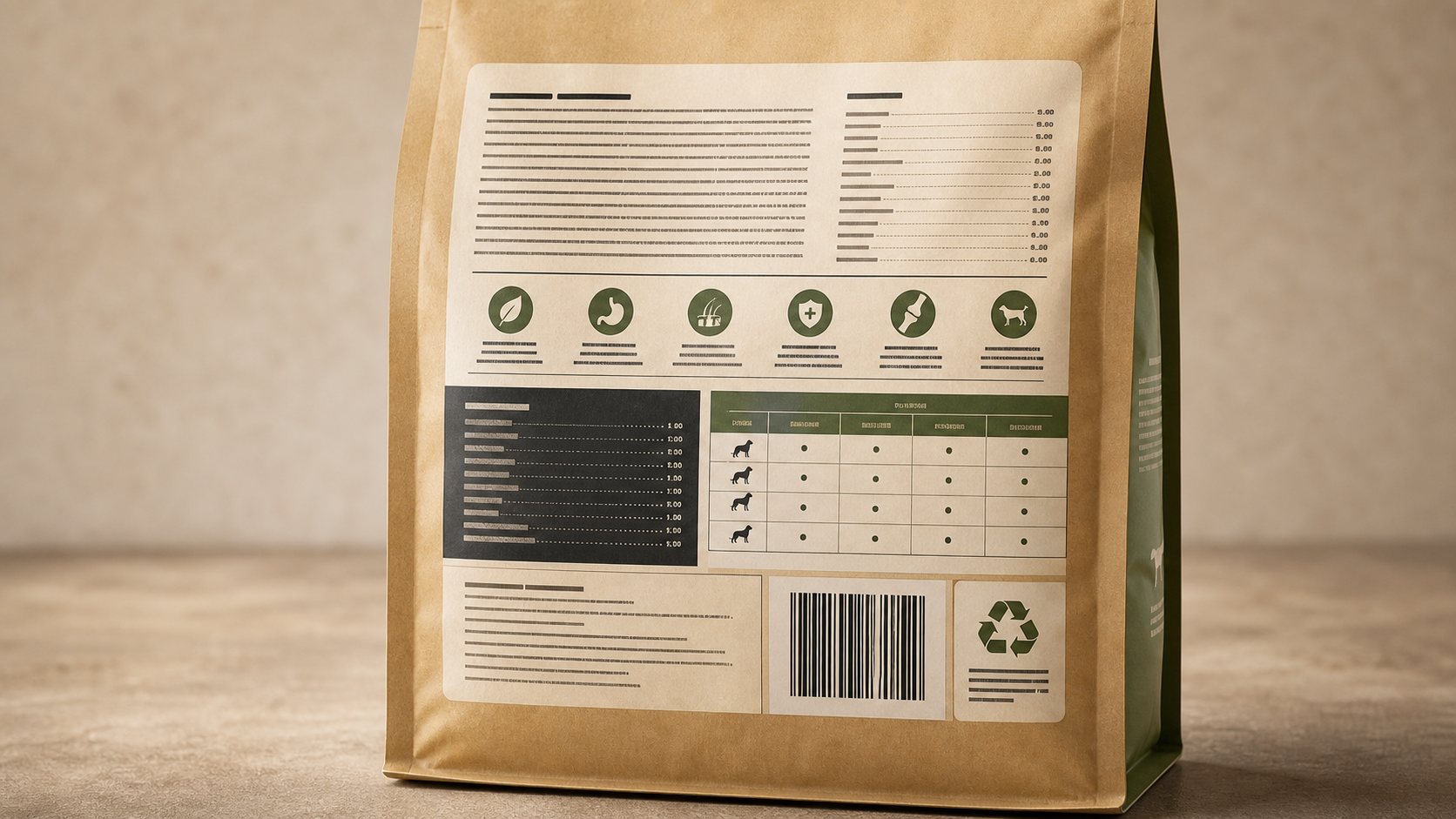
Placez-vous devant n’importe quel rayon de nourriture pour animaux : chaque sac semble crier quelque chose : ancestral, holistique, premium, sans grains, élevé à la ferme. Certains de ces termes véhiculent de vraies informations, mais beaucoup ne sont que du marketing. La vérité utile est imprimée en petits caractères au dos. Une fois que vous savez lire quatre éléments (la liste des ingrédients, l’analyse garantie, la déclaration du stade de vie et le guide d’alimentation), vous pouvez évaluer n’importe quelle nourriture en une minute environ. Voici le décodeur que notre équipe utilise quotidiennement sur le terrain.
Commencez par la liste des ingrédients et son ordre
Les ingrédients sont listés par poids, du plus lourd au plus léger, mesuré avant la cuisson. Cet ordre cache un détail important : la viande fraîche contient environ 70 % d’eau. Ainsi, du « poulet frais » en haut de la liste pèse lourd avant transformation, mais réduit considérablement à la cuisson dans une croquette sèche. C’est pourquoi une étiquette de qualité présente souvent plusieurs protéines animales nommées dans les premiers ingrédients (poulet frais et farine de poulet, par exemple) plutôt qu’une seule viande suivie d’une longue liste d’amidons. En guise de vérification rapide : regardez les cinq premiers ingrédients, ils constituent la majeure partie du sac.
Que signifie réellement « farine de poulet » ?
Une farine est une viande dont l’eau a été extraite, laissant une source de protéines concentrée et fondue. Une farine nommée (farine de poulet, d’agneau, de saumon) est un excellent ingrédient, pas un agent de remplissage. Comme l’eau est déjà éliminée, une farine située en haut d’une étiquette de nourriture sèche apporte souvent plus de protéines réelles que de la viande fraîche listée en premier. L’étiquette à lire avec plus de scepticisme est la version vague : « farine de viande » ou « farine animale » sans nom d’espèce indique que la source peut varier d’un lot à l’autre. Une espèce nommée, qu’elle soit fraîche ou en farine, est le signe qu’une entreprise joue la carte de la transparence avec vous.
Les sous-produits sont-ils mauvais ?
Pas intrinsèquement. Les « sous-produits » désignent principalement les organes et autres parties autres que la chair musculaire, et les organes sont parmi les aliments les plus denses en nutriments qu’un animal puisse consommer (les canidés et félins sauvages les mangent en premier). Les questions légitimes sont les mêmes que pour les farines : l’espèce est-elle nommée et faites-vous confiance à l’approvisionnement de l’entreprise ? De nombreuses excellentes nourritures utilisent fièrement des abats nommés sur l’étiquette (foie, cœur, tripes) tandis que d’autres utilisent le terme générique. Considérez « sous-produits » comme un mot neutre qui mérite une attention particulière, et non comme un signal d’alarme automatique.
L’analyse garantie : minimums et maximums, pas des quantités exactes
Ce petit tableau garantit un minimum de protéines brutes et de matières grasses, ainsi qu’un maximum de fibres et d’humidité. Il s’agit d’un plancher et d’un plafond, pas d’une recette détaillée. Le piège à éviter : on ne peut pas comparer directement les chiffres d’une nourriture humide avec ceux d’une nourriture sèche, car la nourriture humide est majoritairement composée d’eau. Une conserve affichant 10 % de protéines avec 78 % d’humidité est, une fois l’eau retirée, plus dense en protéines qu’une croquette à 30 % de protéines avec 10 % d’humidité. L’astuce pour comparer entre différents formats : divisez le pourcentage de protéines par le pourcentage de matière sèche (100 moins le taux d’humidité). Cela prend dix secondes et permet une comparaison honnête.
La ligne la plus importante : « complet et équilibré » pour un stade de vie
Quelque part sur le sac se trouve une déclaration d’adéquation nutritionnelle. Recherchez des termes comme « complet et équilibré », faisant généralement référence aux profils nutritionnels de l’AAFCO, pour un stade de vie nommé : croissance (chiots et chatons), maintien adulte, ou tous stades de vie. Cette seule ligne vous indique que la nourriture est formulée pour constituer l’alimentation entière, et pour qui. Un chiot ou un chaton en croissance a besoin d’une nourriture spécifiant « croissance » ou « tous stades de vie ». Une nourriture de maintien pour adulte n’est pas assez riche pour construire un organisme. (Bon à savoir : l’étiquetage des aliments pour animaux est moins strictement réglementé au Canada que celui pour les humains, et les marques canadiennes réputées formulent volontairement leurs produits selon ces normes, ce qui renforce l’importance de cette déclaration.) Notre guide sur la nourriture pour chiots explore plus en profondeur l’aspect de la croissance.
Mots marketing vs mots significatifs
Voici la distinction honnête. Mots sans définition réglementée sur un sac : premium, super-premium, holistique, gourmet, naturel (au mieux vaguement définis). Mots qui véhiculent de vraies informations : une espèce nommée pour chaque protéine, un stade de vie spécifique, « complet et équilibré », un fabricant et un pays d’origine mentionnés, et des précisions comme « fabriqué au Canada » par une entreprise qui vous indique où. Les marques fières de leur approvisionnement ont tendance à le dire avec précision. Nos analyses détaillées sur Acana & Orijen et Eukanuba montrent à quoi ressemble cette précision en pratique.
Comment comparer deux sacs en 60 secondes
- Cinq premiers ingrédients : combien sont des protéines animales nommées ?
- Déclaration d’adéquation : est-ce complet et équilibré pour le bon stade de vie ?
- Analyse garantie : les protéines et graisses correspondent-elles aux besoins de votre animal (et ajustées à la matière sèche si vous comparez humide et sec) ?
- Précisions nommées : l’espèce est-elle précisée pour chaque farine ou sous-produit, l’entreprise est-elle réelle et le pays d’origine indiqué ?
- Vérification du guide d’alimentation : une nourriture calorique demande des rations quotidiennes plus petites, donc le coût par jour est plus pertinent que le coût par sac.
Un mot rapide sur le « sans grains »
Le « sans grains » et le « avec grains » sont tous deux des formats légitimes. La réponse dépend avant tout de votre chien ou de votre chat : pelage, qualité des selles, énergie et éventuelles sensibilités. Si vous envisagez un changement, faites-le progressivement sur 7 à 10 jours et consultez votre vétérinaire, surtout pour les animaux ayant des problèmes de santé. Parcourez toute la collection de nourriture pour chiens avec un regard neuf sur les étiquettes et le dos du sac commencera à vous révéler ses secrets.
En résumé
Ignorez le devant du sac, lisez le dos. Des protéines nommées en haut de la liste des ingrédients, une déclaration « complet et équilibré » pour le bon stade de vie, une analyse garantie comparée honnêtement et une entreprise qui nomme ses sources : voilà toute la compétence requise. Maîtrisez ces quatre vérifications et aucun emballage ne pourra vous tromper.
PetMax.ca est un détaillant en articles pour animaux appartenant à des Canadiens et basé dans la région du Grand Toronto et Hamilton. Nous aidons les propriétaires d'animaux depuis 1993 et livrons partout au Canada, avec la livraison gratuite sur les commandes de plus de 89 $* sous conditions. Cet article est fourni à titre informatif et ne constitue pas un avis vétérinaire. En cas de doute sur la santé de votre animal, contactez votre vétérinaire.



Partager:
Le long week-end de la fête du Travail avec votre chien : une dernière liste de vérification pour l'été (2026)
Nouveautés chez PetMax cet automne : manteaux, couchages et arrivages (2026)